 +91 98193 84820
 girish.gemerik@gmail.com
In high-purity pharmaceutical and biotechnological applications, selecting the right valve technology is critical to maintaining sterility, preventing cross-contamination, and ensuring compliance with stringent regulatory bodies.
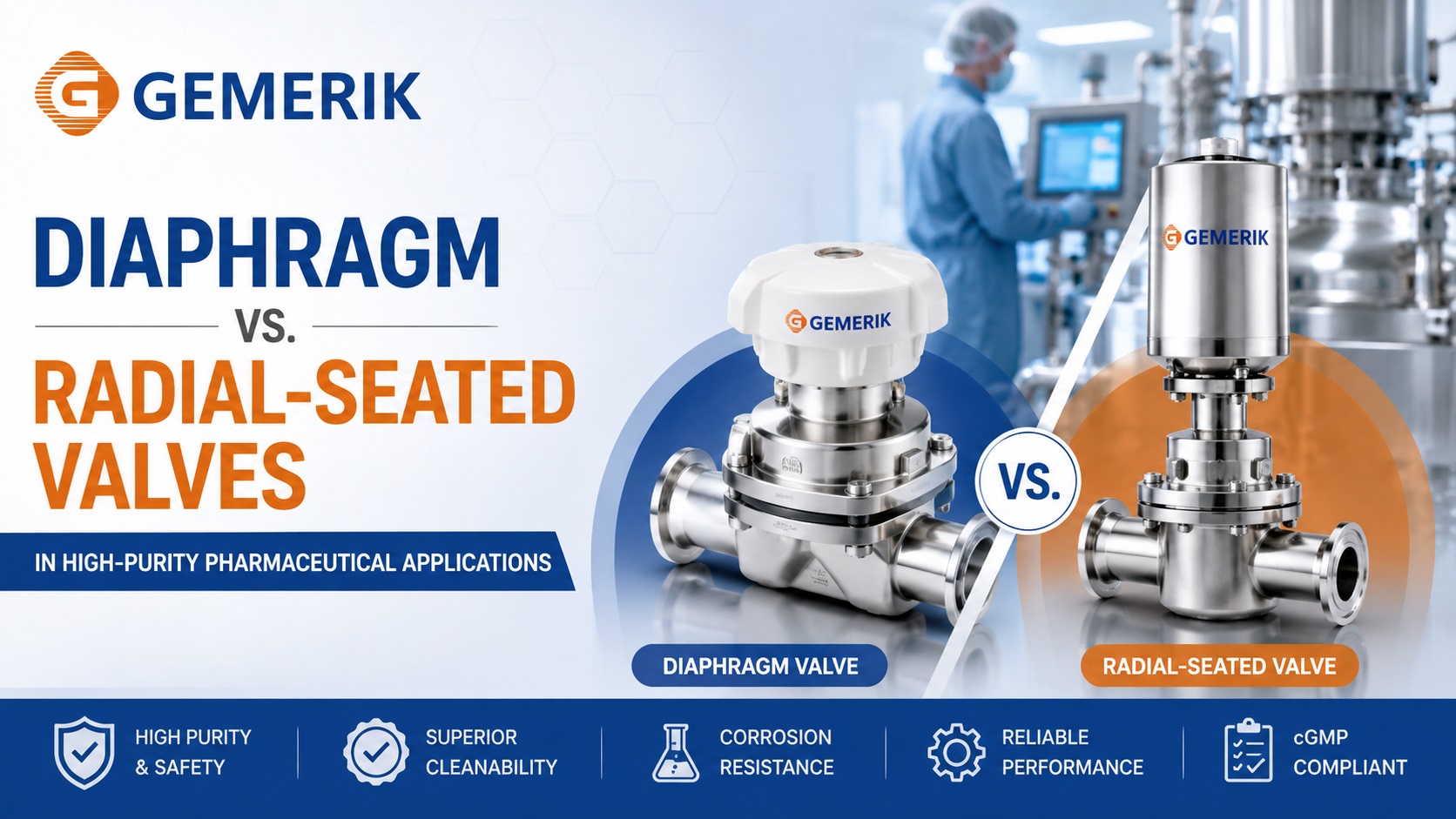
In high-purity pharmaceutical and biotechnological applications, selecting the appropriate valve technology is vital for maintaining sterility, preventing cross-contamination, and complying with stringent regulatory standards. Traditional weir-type diaphragm valves have long served as a reliable standard for mainline process isolation, general utility routing, and fluid control. They feature a flexible membrane pressed down against a central raised ridge by a compressor, offering absolute isolation with zero risk of stem leakage and allowing for easy inline maintenance without cutting the piping network.
On the other hand, radial-seated (radial diaphragm) valves are specifically engineered to address complex spatial and sanitary challenges, such as minimizing dead legs and optimizing drainability. Instead of pressing onto a transverse weir, these valves utilize an axial or radial expanding piston movement that seals symmetrically against a circular, polished radial seat inside the body. This streamlined geometry promotes superior self-emptying and makes them ideal for integration directly onto main process headers as point-of-use, sampling, or dosing valves.
Ultimately, choosing between these two technologies depends on the specific placement within the clean utility loop. Weir-type diaphragm valves excel as versatile, cost-effective options for general process lines, buffer preparation, and clean-in-place (CIP) systems. Conversely, radial-seated valves are best deployed when designing high-purity loops that demand the absolute elimination of dead legs and zero-static integration for pristine point-of-use sampling.
Key Comparison Points
- Flow Path & Design: Weir-type valves route flow over a central raised ridge using a flexible membrane, whereas radial-seated valves feature a symmetrical, radial flow path around a circular seat.
- Drainability: While weir-type valves require careful pipe alignment to avoid pooling, radial-seated valves are engineered specifically for zero-static and self-draining configurations.
- Dead Legs: Weir-type valves can introduce minor dead legs when used as branch connections, whereas radial-seated valves are built for zero-dead-leg point-of-use integration directly off primary headers.
Choosing the right valve technology ensures that your high-purity system maintains optimal clean-in-place (CIP) and steam-in-place (SIP) efficiency without compromising sterility.